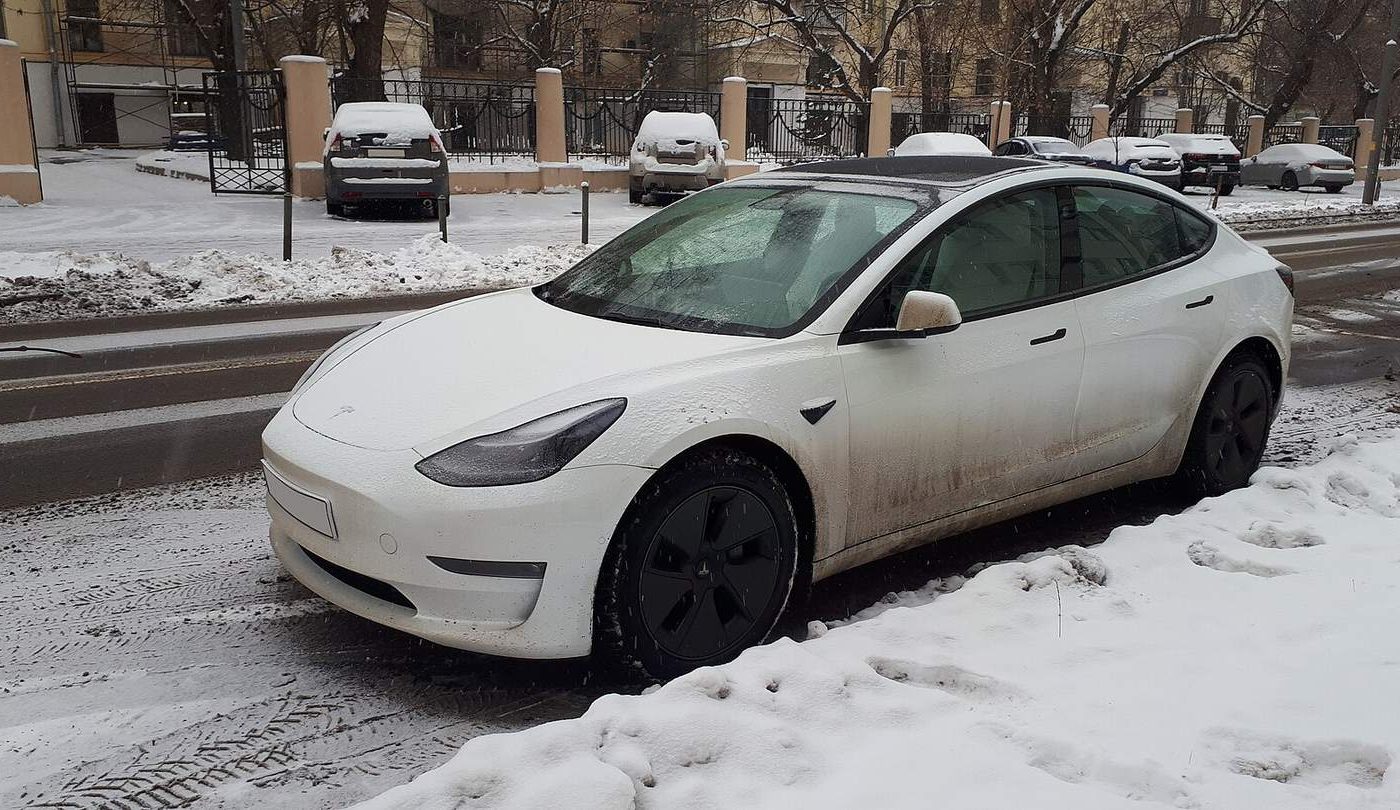
Expect less range from your Tesla once Ontario turns cold, but not as much as many new owners fear. Recurrent’s 2025/2026 winter study of more than 30,000 EVs found the average EV keeps about 78% of its ideal-weather range at 0°C and about 70% at −7°C, and it ranks Tesla models among the best performers. This guide covers Tesla winter range in Ontario and the habits that win most of it back: preconditioning, scheduled departure, smart charging and a few ice-fighting tricks.
We already have a separate guide to winter tires for Model 3 and Model Y in Ontario. This one is about everything else: range, heat, charging and getting out of the driveway on an icy January morning.
Tesla winter range in Ontario: what to expect
Every EV uses more energy in the cold. The battery is less efficient when it’s cold, heating the cabin takes energy, and slush, snow and winter tread all add rolling resistance. Short trips hurt the most, because the car spends a big share of each drive warming the battery and cabin from scratch.
- Average EV at 0°C: about 78% of its best-case range (Recurrent, 2025/2026 study).
- Average EV at −7°C: about 70% of its best-case range.
- Heat pump bonus: Recurrent found a heat pump adds roughly 10% of range at 0°C. Not sure if your car has one? Tap Controls > Software > Additional Vehicle Information.
Those percentages compare against each model’s best real-world range in mild weather, not the official rated range. Your numbers will depend on speed, trip length and how warm you like the cabin.
On very cold mornings you may see a blue snowflake on the screen. Tesla’s manual explains that part of the battery’s energy is temporarily unavailable because the battery is cold, and regenerative braking, acceleration and charging speed may be limited. It disappears once the battery warms up. Nothing is wrong with the car.
Precondition while plugged in
This is the biggest single win. Preconditioning warms the battery and cabin before you leave, so you start with full regen, a clear windshield and a warm seat. If the car is plugged in, the energy comes from the wall instead of your battery.
Three ways to do it, all from Tesla’s cold-weather guidance:
- Schedule it: tap Controls > Schedule (also on the climate and charging screens) and set when you want to leave. The car works out when to start.
- From the app: open Climate and set a temperature. This also warms the battery as needed.
- Defrost Car: in the app, Climate > Defrost Car melts snow, ice and frost on the windshield, windows, mirrors and charge port, and warms the battery too.
Tesla recommends starting climate at least 30 to 45 minutes before you leave. Leave the car plugged in at home whenever you can: Tesla says this lets the charging system, not the battery, keep the battery warm.
Set up Scheduled Departure with overnight charging
The Schedule screen does two jobs at once: Precondition (be warm by a set time) and Charge (charge in a set window). Use both. Tesla’s manual points out that if charging finishes hours before you leave, the battery cools back down and needs energy to warm up again. Timing the charge to finish close to your departure means a warmer battery and less wasted energy.
In Ontario this lines up nicely with the Ultra-Low Overnight (ULO) price plan. From November 1, 2026, the Ontario ultra-low overnight rate drops to 3.7¢/kWh between 11 p.m. and 7 a.m. every day. A schedule that charges overnight and finishes around 6:30 a.m., with preconditioning set for your usual departure, gets you cheap energy and a warm car.
Setting up home charging for the first time? Our companion guide, Tesla home charging in Ontario, walks through Level 2 installs, ESA permits and ULO scheduling step by step.
Cabin Overheat Protection, Keep Climate On and Camp Mode
Owners often ask whether Cabin Overheat Protection matters in winter. It doesn’t do anything for warmth. According to Tesla, it only cools the cabin when it gets above 40°C (or your chosen temperature) and switches off 12 hours after you leave the car. You’ll find it under Controls > Safety > Cabin Overheat Protection, and you can leave it on or set it to Off for the season. It simply won’t trigger in an Ontario winter.
For heat while parked, use Keep Climate On, Pet Mode or Camp Mode on the climate screen. They’re great for waiting in a parking lot at the kids’ hockey practice, but they draw from the battery when you’re not plugged in, so avoid them when your charge is low. Never leave a child unattended in the car.
Drive smarter to stretch winter range
- Heat yourself, not the whole cabin. Seat heaters and the heated steering wheel use less energy than the cabin heater. Tesla suggests lowering the cabin temperature and leaning on the seat heaters.
- Try Chill acceleration. Tesla’s manual says a lower acceleration mode lets the heat pump take more heat from the battery to warm the cabin, which improves efficiency in cold weather.
- Ease off on the 401. Speed costs more energy in winter. Driving a bit slower and avoiding hard acceleration helps.
- Check tire pressure often. Tesla says tires lose about 1 PSI for every 6°C drop in temperature. Correct pressure helps both range and pothole protection.
- Expect weaker regen at first. Regenerative braking is limited until the battery warms up. Preconditioning before you leave avoids most of this.
- Tell the car about winter tires. After a swap, select winter tires under Service > Wheel & Tire > Tires so regen recalibrates faster.
Snow, traction and winter tires
Winter tires matter more than anything else for grip. Tesla recommends them for snowy or icy conditions, and in Ontario they can also save you money. Since 2016, insurers in Ontario have had to offer a discount for winter tires under O. Reg. 222/15. When the rule took effect, the province said the discount averages two to five per cent. Each insurer sets its own conditions, such as install dates, so check with yours. Sizes, TPMS sensors and timing are covered in our Tesla winter tire guide for Ontario.
Model 3 and Model Y don’t have a button labelled “snow mode”. Traction and stability control work in the background all the time. The setting worth knowing is Slip Start under Controls > Dynamics. It allows the wheels to spin so you can rock free of deep snow, slush or ice. Turn it on only when you’re stuck, then turn it off. Some AWD models also offer Off-Road Assist for soft surfaces. Neither should be used with Autopilot features.
Beat the ice: door handles, wipers, mirrors and the charge port
- Frozen door handle: on a Model Y, Tesla says to press firmly on the front of the handle so it rocks inward and breaks the ice, then press the rear of the handle as usual. Don’t use tools or force. A little WD-40 on the handle pivot pins before a freeze helps prevent it. You can also add Unlatch Door as a quick control in the app to pop the driver’s door open.
- Wipers: if snow or freezing rain is coming, tap Controls > Service > Wiper Service Mode before you park. The wipers lift off the base of the windshield so they defrost along with the glass. Cars with wiper defrosters can run them for 30 minutes at a time.
- Mirrors: turn off Auto-Fold if ice is expected. Ice can stop the mirrors from folding or unfolding. They heat automatically during preconditioning or when the rear defroster is on.
- Charge port: if the latch freezes and the cable is stuck, use Controls > Service > Inlet Heater (North American cars) or run Defrost Car from the app. A schedule helps prevent this in the first place.
- Windows: in the cold, the side windows stop slightly below the trim so they don’t freeze shut. That’s normal.
Supercharging in the cold
A cold battery charges slowly, so the trick is to arrive warm. Use the car’s navigation to route to the Supercharger. Tesla says the car then preheats the battery on the way, and recommends navigating there for at least 30 to 45 minutes before you arrive. If the charger is closer than that, precondition the car before you set off.
- Expect slower speeds for the first few minutes if the battery is still cold. They improve as it warms.
- Cars with a heat pump can give off odourless steam from the front while Supercharging in the cold. Tesla says this is normal.
- Scheduled charging doesn’t apply at Superchargers. The car ignores home charging schedules at fast chargers.
- Leave a bigger buffer in winter, especially on long stretches like the 400 north to cottage country or the 401 between cities. Our charging stop checklist helps you plan a backup.
Quick winter checklist for Ontario Tesla owners
- Winter tires on, and winter tires selected in the car’s settings.
- A Precondition + Charge schedule set for your weekday departure time.
- ULO plan (or your best overnight rate) and charging set to finish near departure.
- Winter washer fluid topped up, and an ice scraper and brush in the frunk.
- Wiper Service Mode and Auto-Fold off before storms.
- Tire pressures checked after every big temperature drop.
- Winter road trips planned with a backup charger.
Frequently asked questions
How much range does a Tesla lose in winter in Ontario?
It depends on temperature, speed and trip length. Recurrent’s 2025/2026 study found the average EV keeps about 78% of its best range at 0°C and about 70% at −7°C, with Tesla models among the best performers. Short trips in deep cold lose the most.
Should I keep my Tesla plugged in during winter?
Yes, whenever you can. Tesla recommends leaving the car plugged in when it’s not in use, so the charging system keeps the battery warm instead of the battery itself, and preconditioning runs off grid power.
Is it bad to charge a Tesla in the cold?
No. Charging is just slower when the battery is cold. At home, a schedule that finishes close to departure keeps the battery warmer. For Superchargers, navigate there so the car preheats the battery on the way.
Does Cabin Overheat Protection drain the battery in winter?
It shouldn’t. Tesla says it only cools the cabin when it goes above 40°C (or your chosen temperature), which won’t happen in an Ontario winter. You can leave it on or switch it off for the season.
Do I get an insurance discount for winter tires in Ontario?
Ontario requires insurers to offer one. When the rule took effect, the province said the discount averages two to five per cent. Each insurer sets its own rules, including install dates, so call yours to confirm.
Share your winter tips
Got a winter trick that works for you, like a favourite schedule, a de-icing hack or a Supercharger that’s great in a snowstorm? Bring it to Tesla Model Y & 3 [Ontario, Canada], where 17,000+ Ontario owners swap real-world winter advice every day.
On X? Join our community, Tesla Model* [Ontario, Canada], for quick updates and owner chat.
Sources: Tesla Model Y Owner’s Manual: Cold Weather Best Practices · Tesla: Scheduled Precondition and Charge · Tesla: Operating Climate Controls · Recurrent: Winter EV range loss study · Ontario Newsroom: winter tire discount · Ontario Energy Board: electricity price plans
Photo: “Tesla Model S in snow (front view)” by Kirill Borisenko, Wikimedia Commons, CC BY-SA 4.0. The car pictured is a Model 3. Resized.

About the author: Sivachandran Bharathi is a Lead Software Engineer based in Markham, Ontario, with 10+ years of experience building enterprise systems for banks and financial institutions worldwide, and a Master of Applied Science in Computer Engineering with research in machine learning. Connect on LinkedIn.