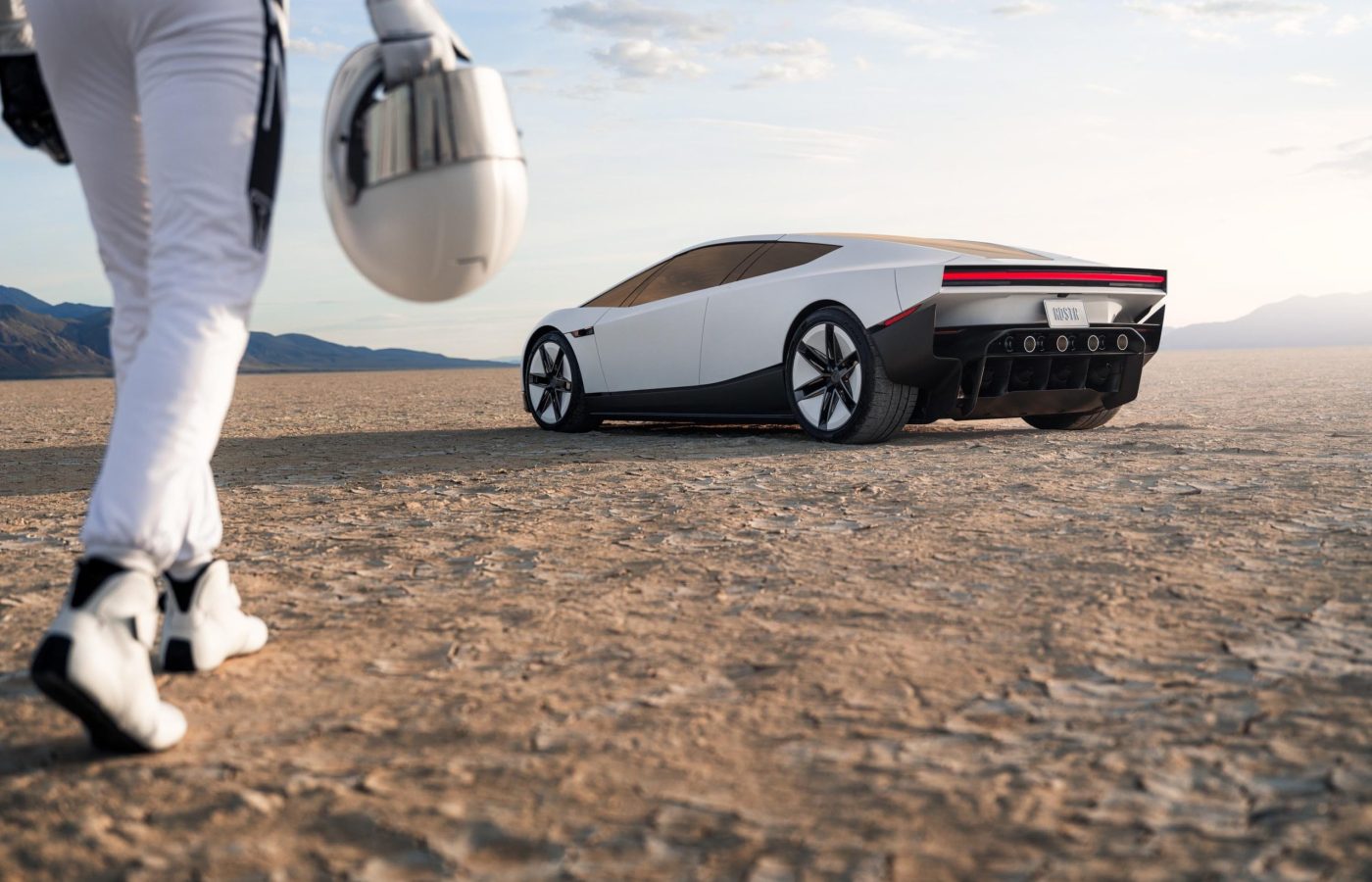
Photo: Tesla
The new Tesla Roadster specs are finally out, and they are wild. Tesla says the car hits 60 mph (about 97 km/h) in under 1.6 seconds in its basic form, and under 0.59 seconds in the top version. Range is claimed at over 300 miles (about 483 km). In Canada, you can reserve one today for $70,000 CAD, but the final price is still unknown and production is aimed at 2028.
We already covered the big reveal night in our Roadster unveiling news story. This article goes deeper. I will explain every spec and every piece of technology in simple words, with no engineering degree needed.
Tesla Roadster specs at a glance
First, a quick note. Some numbers come straight from Tesla. Others come from Tesla engineers speaking to reporters after the event. Tesla could still change any of them before 2028. I have marked where each one comes from.
| Spec | What we know | Source |
|---|---|---|
| Versions | Performance, Thrust, Rocket | Tesla |
| Seats | 2 (Performance, Thrust), 1 (Rocket) | Tesla |
| 0–60 mph (about 0–97 km/h) | Performance: under 1.6 s. Thrust: under 0.9 s. Rocket: under 0.59 s | Tesla |
| Demo run at the event | 0.81 s (about 0.67 s with the usual “rollout” trick removed) | Tesla clip, EVwire |
| Top speed | Over 230 mph (about 370 km/h) | Tesla |
| Range | Over 300 miles (about 483 km); engineers say about 310–320 miles (about 500–515 km) in normal driving | Tesla, InsideEVs |
| Power | Up to 1 megawatt (1,000 kW, about 1,341 hp). Base version reported at 800+ kW (about 1,073 hp) | Tesla, InsideEVs |
| Torque | Reported 885 lb-ft (about 1,200 Nm) base, over 1,032 lb-ft (about 1,400 Nm) top | InsideEVs |
| Motors | Two motors, both at the back (rear-wheel drive) | Tesla engineers |
| Battery size | Not announced. Reported as “substantially more than 100 kWh” | MotorTrend |
| Battery voltage | Reported between 800 and 1,000 volts | InsideEVs |
| Fast charging | Up to 500 kW on a V4 Supercharger; about 10 minutes for 15–85% (reported) | InsideEVs |
| Weight | Target about 1,700 kg (about 3,700–3,750 lb) | Tesla engineers |
| Thruster air tank | Thrust: about 200 litres. Rocket: about 600 litres in total, feeding 10 nozzles | Tesla engineers |
| Canadian reservation | Performance: $70,000 CAD. Thrust: $350,000 CAD. Rocket: invite only | Tesla.ca |
| Final price | Not announced | – |
| Production | Targeted for 2028, in Texas | Tesla |
The three versions, in plain words
Performance: the “road ready” one
This is the version most people will get. It seats two. It uses moving wings and a fan system (explained below) to stick to the road. Tesla says it does 0–60 mph in under 1.6 seconds. Tesla has told older reservation holders their spots were moved to this version, with an option to upgrade.
Thrust: the “race ready” one
This also seats two. It adds a tank of squeezed air and four small air jets at the back. When you fire them, they push the car forward like a released balloon. Tesla says this gets it to 60 mph in under 0.9 seconds. It is a “limited release.”
Rocket: the “air ready” one
This one seats only the driver. The passenger seat space is used for more air tanks. Jets around the whole car can push it forward, up and sideways. Tesla’s own words: “So yes, it can fly.” It is invite only, not offered in every region, and Tesla says it is not approved for public roads.
Battery and motors: where the speed comes from
Think of the battery as the fuel tank and the motors as the engine. Tesla says the new battery and rear motor unit together make 1 megawatt of power. Tesla’s display at the event said that is one-third more than a Model S Plaid, with half the mass. MotorTrend quoted slightly different figures: 50% more power and 30% less weight than the Plaid drive unit. If you know the Plaid from our Model S owner’s guide, that gives you a sense of the jump.
There are two motors, both at the back. Each one can push its own rear wheel a little harder or softer. This helps the car turn sharply, a trick called “torque vectoring.” People at the event also spotted an extra high-voltage plug on the battery. Some think that hints at a future front motor, but Tesla has not said so.
The battery uses large round cells that look like Tesla’s 4680 type, with a new chemistry and a titanium cover for strength. It is split into four blocks with cooling pipes snaking between the cells. Tesla has not shared the battery size. MotorTrend says Tesla asked it not to publish the number, but called it “substantially more than 100 kWh.” For comparison, a Model 3 Long Range is roughly 75 to 80 kWh.
Higher voltage (reported at 800 to 1,000 volts) works like a wider hose. It lets more energy flow in and out with less heat. That is why the Roadster is said to be Tesla’s fastest-charging car yet.
Charging and range for Canadian drivers
Tesla officially claims over 300 miles, or about 483 km. Tesla’s chief engineer Lars Moravy reportedly said 310 to 320 miles (about 500 to 515 km) in normal driving. That is far less than the 620 miles (about 1,000 km) promised for the 2017 prototype. Expect less in an Ontario winter, like every EV.
On charging, Moravy reportedly said the car can take up to 500 kW on Tesla’s newest V4 Superchargers. He said 15% to 85% should take about 10 minutes. MotorTrend quoted 10 to 12 minutes for 10% to 80%. The charge port hides behind the rear wing. Remember that most Canadian Superchargers today are not V4 cabinets that deliver 500 kW, so real stops may be slower. Our guide to planning a smoother charging stop still applies.
The SpaceX thrusters, explained simply
This is the part everyone is talking about. The thrusters are not rocket engines with fire. They are “cold-gas” thrusters. That just means a tank of very tightly squeezed gas (nitrogen, according to MotorTrend) is let out through small nozzles. The rushing gas pushes the car the other way.
- The tanks: They are carbon-fibre wrapped tanks called COPVs, the same kind SpaceX uses in rockets. Tesla said on X that “every usable void in the car” is packed with them.
- The pressure: MotorTrend reports up to 10,000 psi. The car’s screen at the event showed “booster ready” at 5,500 psi. For scale, your tires are around 42 psi.
- Thrust version: one roughly 200-litre tank where the trunk would be, feeding four rear nozzles through equal-length pipes.
- Rocket version: about 600 litres in total, feeding 10 nozzles around the car.
- The valves: They are opened by electric actuators. MotorTrend says they borrow parts from the ankle of Tesla’s Optimus robot. Tesla says they can make tiny corrections in a fraction of a second to keep the car steady in the air.
- How long it lasts: InsideEVs reports one full tank gives about five to six seconds of boost.
- Refilling: It reportedly takes two to six hours today with a high-pressure system. Tesla says it is working on a version under 30 minutes. How owners would refill at home is still unclear.
At the event, a Roadster drove up a curved ramp until it was upside down, then flipped and landed. It also hopped over a Cybercab, Cybertruck, Semi, Model Y and Model 3. Musk noted the demo was driven autonomously “to make sure we don’t kill anyone.”
Fans that suck the car to the road
Normal sports cars use wings that press the car down, but only when moving fast. The Roadster adds powered fans at the back plus a seal around the bottom edge. The fans pull air out from under the car, so it gets sucked toward the ground like a vacuum cleaner on a carpet.
Tesla says this suction is strong enough to hold the car upside down, even while it is parked. Because the fans work at any speed, the car has grip from the moment it moves. The fans can also lift up out of the way of road debris. On a track, you can switch between “high downforce” for corners and “low drag” for straight-line speed.
Design: shaped like a spy plane
- Shape: a low, sharp wedge. Tesla says the inspiration was the SR-71 Blackbird and F-35 jets.
- Hidden aero: hidden headlights, one full-width taillight, flush wings and vents, plus thin-spoke lightweight wheels.
- Roof: despite the name, it is not a soft-top. The glass roof panels lift out, giving an open “T-top” feel.
- Ano White paint: inspired by rocket coatings that resist sun damage, extreme cold and rust.
- Gold glass: tinted windows meant to look like astronaut helmet visors, with titanium trim.
- Light materials: magnesium, titanium and carbon fibre throughout, on an aluminium and carbon fibre frame.
- Tires: a display car wore sticky Pirelli Trofeo RS tires.
Inside the cockpit
The seats are bolted in place to save weight. Instead of moving the seat, the steering yoke moves toward you. The interior is white with grey microsuede on the seat sides for grip.
The yoke has a DRS button (opens the rear wing for less drag), turn signal buttons and a Boost button. There is a centre touchscreen plus two small screens in front of the driver. A wireless phone charger is included. The yoke is only on the left side.
Software: steer-by-wire, drive modes and FSD
As a software engineer, this is the part I find most interesting. The Roadster is fully “by-wire.” There is no metal link between your hands and the wheels, or your foot and the brakes. Your inputs go to computers, which then steer, brake and accelerate. The Cybertruck already does this for steering. Software can tune how the car feels on the fly, but it also means the code has to be extremely reliable.
- Drive modes: Comfort, Balance, Sport and Custom. Custom lets you set acceleration, ride, handling, front and rear wings, ride height, the hood vent and side air panels.
- Track Mode: lowers the car and stiffens the suspension. It shows battery and motor temperatures, aero balance and brake balance. You can also turn off stability and traction control.
- Retro look: a dark mode with red text, and a light mode styled like the 2017 prototype’s screen.
- Easter egg: shifting into reverse shows Tesla’s cartoon hedgehog on the backup camera screen.
What about Full Self-Driving? Tesla calls the Roadster “the best of the last human-driven cars.” Musk said it will be “the only manually driven car that Tesla makes” in the long term. Tesla has not announced FSD (Supervised) for the Roadster. It has also not confirmed which computer or camera set it will use, though one display car showed a new side camera.
Price, production and Canada
Here is what Canadians need to know, from Tesla’s Canadian reservation page:
- Performance: $7,000 CAD now (listed as fully refundable), plus $63,000 CAD within 10 days. Total: $70,000 CAD.
- Thrust: $7,000 CAD now, plus $343,000 CAD within 10 days. Total: $350,000 CAD.
- Rocket: invite only, no online reservation.
These are deposits, not the car’s price. Tesla has not said what the Roadster will cost. Back in 2017, Musk quoted about US$200,000 for the earlier design. Tesla’s terms say a reservation is not an order. Refunds for changes will not be issued, so read the terms before you wire money. Musk and Moravy say production will start in 2028 at Giga Texas. This car was first promised for 2020, so a healthy dose of patience is wise.
Canadian road rules are another open question. The Rocket is not road approved anywhere, and Musk said some thruster moves may not be legal in every place. We have not seen any comment from Transport Canada on the Roadster yet. You can see Tesla’s official details on the Tesla Canada Roadster page.
My take
The Roadster will not change daily life for most of us driving a Model 3 or Model Y through Toronto traffic. But ideas tested in halo cars often reach everyday Teslas later. Think faster charging, higher-voltage batteries, by-wire controls and smarter software. That is the real reason to watch this car closely.
Want to chat about it with other owners? Join Canada’s most active Tesla community, with 17,000+ members sharing real-world tips and news: Tesla Model Y & 3 [Ontario, Canada]. Would you put down $70,000 to reserve one? We’d love to hear your take.
Sources: Tesla Roadster page, Tesla Canada reservation page, TechCrunch, InsideEVs, MotorTrend, EVwire, The Verge, AP News, Global News.
About the author: Sivachandran Bharathi is a Lead Software Engineer based in Markham, Ontario, with 10+ years of experience building enterprise systems for banks and financial institutions worldwide, and a Master of Applied Science in Computer Engineering with research in machine learning. Connect on LinkedIn.