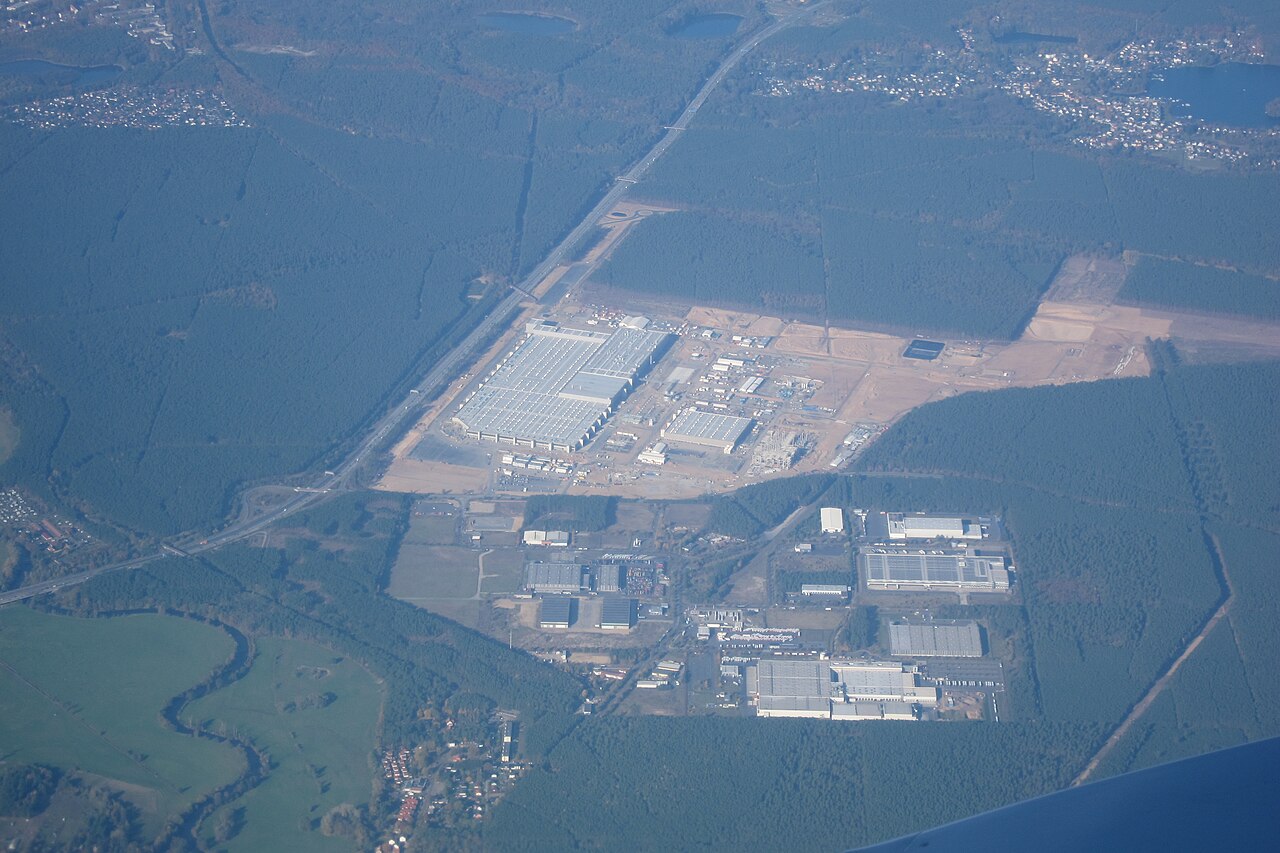
Tesla is preparing the next big step for Gigafactory Berlin-Brandenburg: a second production hall north of the existing plant in Grünheide that would be more than twice the size of today’s main building, according to German broadcaster rbb and follow-up reporting.
@NotATeslaApp summarized the plan on October 15: the new hall would cover about 536,000 square metres (roughly 5.76 million sq ft), versus about 219,000 m² for the current hall. Tesla expects to file permit applications in December 2026, with construction potentially starting in 2027. The full build-out toward up to 1 million vehicles per year is described as a roughly ten-year project.
In a statement to rbb, Tesla said the phased expansion was already outlined in its 2023 partial-approval application, and that an October 2024 approval confirmed the project is, in principle, eligible for approval. The new northern-hall filing builds on that foundation. Reporting from EVwire and Not a Tesla App notes accompanying infrastructure such as a dedicated substation and expanded on-site water treatment, a sensitive local issue since the factory broke ground.
Why it matters for Canada
Giga Berlin currently builds Model Y vehicles for Europe and several export markets, including Canada. Near-term, the plant is already ramping: management has targeted about 7,500 vehicles per week (~375,000 per year), with weekly output recently reported around the mid-6,000s after extra shifts and hiring. Battery-cell investment at the site is also rising, with 4680 capacity plans expanded and cell production targeted for 2027.
A larger European factory does not instantly change Canadian delivery timelines, but more Grünheide capacity is one of the few levers that can ease export supply for markets like ours—especially after recent Canadian Model 3 Premium order pauses tied to import quotas.
For Ontario and other Canadian Model Y buyers who sometimes see European-built cars on the order form, Grünheide capacity is more than a German story. Extra hall space, battery cells on-site, and a path toward million-unit annual capacity are the kinds of long-cycle investments that eventually show up as shorter waits and more configurations available for export markets—if permits and demand both hold.
Sources: Not a Tesla App, EVwire, @NotATeslaApp on X, rbb (via those outlets)