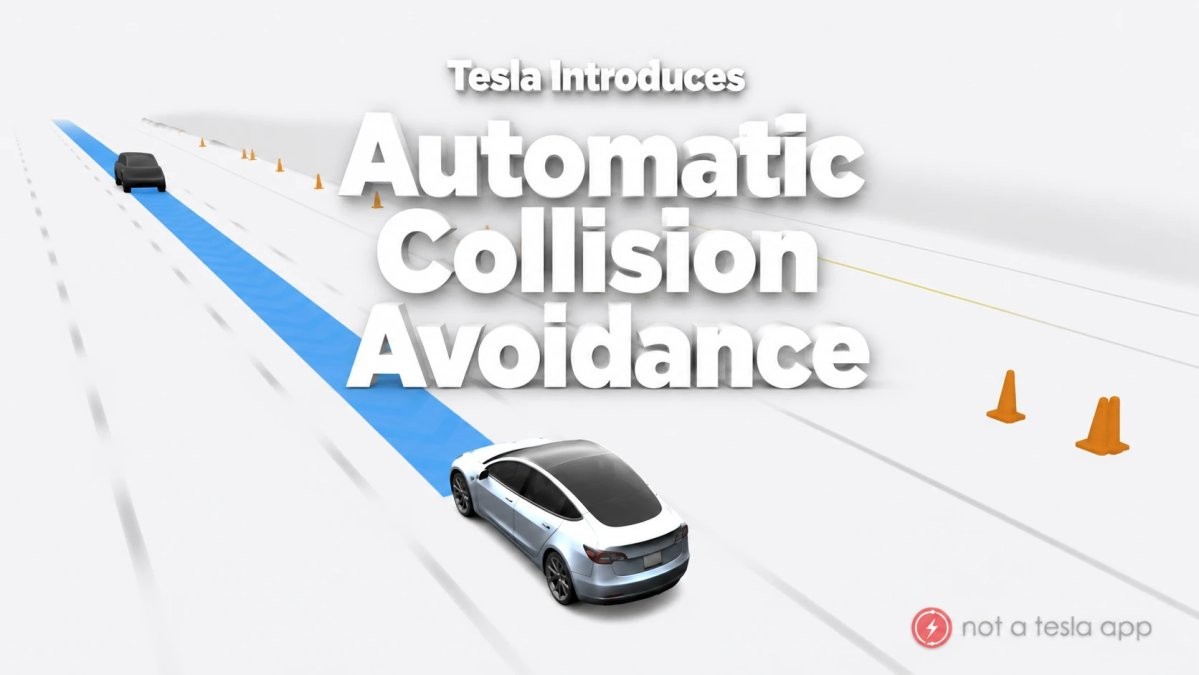
Tesla’s release notes for software update 2026.38.5.12 spell out a safety feature many Canadian HW4 owners already have, or are about to get with FSD (Supervised): Automatic Collision Evasion. It can turn FSD on by itself while you are driving manually, then try to steer and brake around trouble before handing control back. It is not Autopilot comfort driving, and it is not a licence to look at your phone. It is a last-resort layer on top of Automatic Emergency Braking.
Tesla’s short in-car note is sparse. The clearer picture comes from Tesla’s owner’s-manual detail as reported by Not a Tesla App when the feature first appeared earlier in 2026, plus the wording that now ships again in the 2026.38.5.12 release notes. Here is what Canadian owners should know before winter highway season gets worse.
What Tesla says it does
According to the 2026.38.5.12 notes, Automatic Collision Evasion activates Full Self-Driving (Supervised) to try to keep the vehicle safe and then continue driving. It can engage while you are driving manually when:
- the car detects you are not attentive enough (Tesla’s example is reaching toward the back seat), or
- Full Self-Driving (Supervised) may have been unintentionally disengaged
Not a Tesla App’s earlier write-up, based on Tesla’s owner’s manual, also describes a second family of triggers: an imminent frontal collision where braking alone may not be enough, on a controlled-access highway, with no pedestrians or cyclists in the path, and with roads that are not wet or slippery. Speeds in that reporting run up to 85 mph (about 137 km/h) for the highway case, and about 22.5 to 85 mph for the inattention case on more road types. Always defer to the manual in your car if the wording differs.
Who can get it
On the current North American branch, trackers list Automatic Collision Evasion on HW4 (AI4) Model S, 3, X, Y and Cybertruck vehicles that have FSD (Supervised) enabled. Not a Tesla App reported the feature as North America-focused when it launched. HW3 cars and cars without FSD should not expect this behaviour. If you only have Autopilot Basic or Enhanced Autopilot, this is not a free add-on.
Confirm FSD is purchased or subscribed and turned on under Controls > Self-Driving. The feature is not a separate toggle in the short release-note text; it rides with FSD being available and enabled.
How override works
Not a Tesla App’s owner’s-manual summary says that during an active evasive manoeuvre the accelerator is muted, a light brake tap slows the car but does not cancel the manoeuvre, and you need firm, deliberate steering input to take over. When the hazard clears, the car chimes and asks you to resume. Tesla also warns that this is not general obstacle avoidance or an automatic lane-change assistant. Treat it like airbags: you hope it never fires, and you still drive as if it will not.
What it means for Canadian owners
Winter roads matter. The frontal-collision path described in the manual summary needs roads that are not wet or slippery. That excludes a lot of Ontario and Prairie driving from November through March: black ice, slush, freezing rain and freshly salted but still slick pavement. Do not assume the car will swerve for you in a snow squall on the 401.
Highway vs city. The high-speed frontal case is framed around controlled-access highways. City streets, construction zones and two-lane county roads are a different story. Cabin-camera attention monitoring still applies everywhere FSD runs, and winter jackets, hats or a fogged cabin camera can confuse driver monitoring.
CAD cost. There is no separate Canadian price for Automatic Collision Evasion. It comes with FSD (Supervised) on supported HW4 cars. Check current FSD purchase and subscription prices on Tesla Canada’s FSD page before you buy for this feature alone.
What you should do. Keep FSD enabled if you paid for it, keep the cabin camera clear, and practise the firm-steering takeover on an empty lot only if you want to feel the resistance, not on a live highway. If the car ever intervenes, pull over when safe, note the speed and road condition, and check for a service message. Pair this with common winter habits: proper tires, longer following distance, and no phone in hand.
HW compatibility. HW4 cars on the 2026.38.5.x North America builds are the ones showing the feature in tracker notes. Intel MCU vs AMD MCU is separate from HW3 vs HW4; Automatic Collision Evasion is tied to the HW4 FSD stack in the sources above.
Bottom line
Automatic Collision Evasion is Tesla folding FSD into an emergency safety net for manual drives on supported HW4 cars. It is useful context while 2026.38.5.12 rolls through Canada, but wet and slippery roads can take the highway swerve case off the table exactly when Canadian winters get ugly. Stay the driver. For the related software wave, see our note on FSD v14.3.13 builds 2026.38.5.10 and .5.11.
Questions about FSD behaviour in snow? Ask in our Facebook group, Tesla Model Y & 3 [Ontario, Canada], or join our X community Tesla Model* [Ontario, Canada].