Every Ontario winter, drivers end up in the same spot: a wheel spinning on packed snow at the end of a driveway, on an icy side street, or on a rural shoulder. A Tesla’s traction control is very good, but when a tire sits on polished ice, there’s nothing for it to grip. That’s what traction tracks are for.
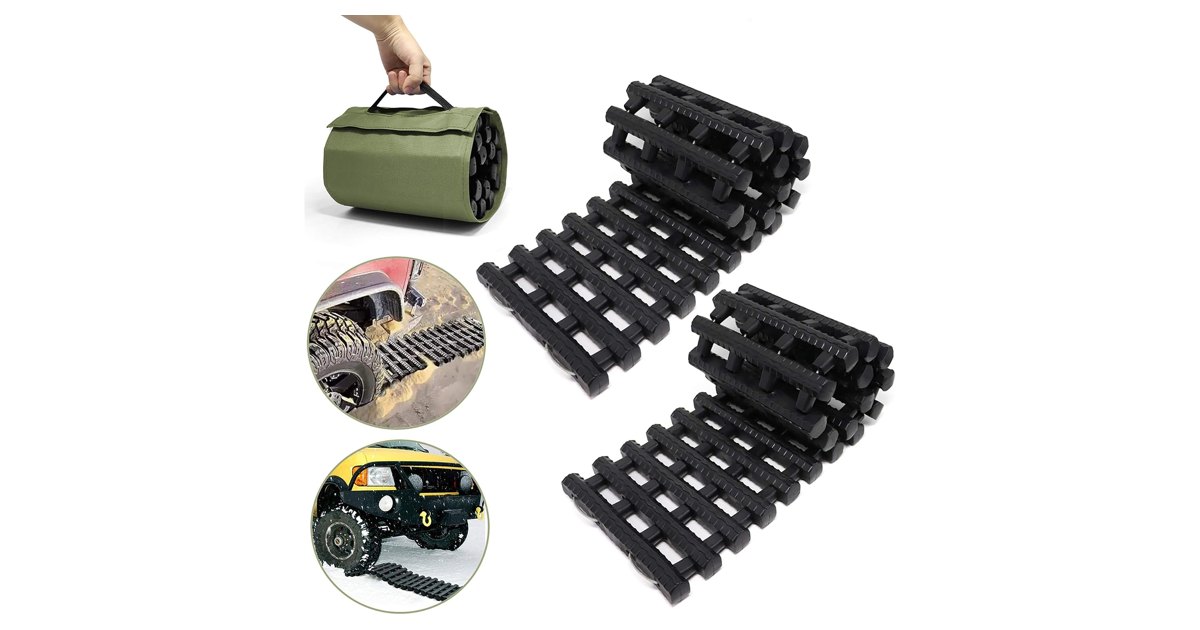
Our pick is the Reliancer roll-up traction tracks on Amazon.ca, a pair of rubber recovery tracks that roll up small enough to live in your frunk or sub-trunk. Here’s how they work with your Tesla’s own settings, where they fall short, and who can skip them.
The problem it solves
The Ontario government’s winter driving guide lists traction mats (or sand) as part of the winter survival kit it recommends keeping in your vehicle, next to a shovel, a flashlight, a blanket and jumper cables. Winter tires do most of the work, but once a tire polishes a groove into ice, spinning harder only makes it slicker.
A traction track gives the tire something rough and solid to climb onto. You wedge it against the spinning tire, then drive slowly onto it and off the slippery patch. It can save you a long wait for a tow on a cold night.
What you get
According to the Amazon.ca listing, the Reliancer set includes two tracks, each about 31.5 by 8.6 inches. They’re made of thermoplastic rubber (TPR) segments joined by a galvanized steel cable, with steel handles at the ends. The listing says each track rolls up to about 9 by 6.6 by 5.6 inches and comes with its own canvas carry wrap. Reliancer rates them for vehicles up to 7 tons, which covers any Model 3 or Model Y with plenty of margin.
The roll-up design is the main reason to choose these over rigid off-road boards, which are often a metre long and awkward in a Model 3 trunk. Rolled up, these can sit in the frunk or the under-floor storage, always in the car without eating cargo space. They aren’t light, though: the listing’s shipping weight for the pair is about 7.3 kg, so plan where they’ll sit.
When we checked on November 17, 2026, the listing showed 4.3 out of 5 stars from about 326 ratings, at about C$102. Prices change often, so check the listing before you buy.
How it works with your Tesla’s own settings
Tesla’s owner’s manual describes a setting called Slip Start (under Controls > Pedals & Steering on the Model Y). Normally, traction control limits wheel spin. Slip Start lets the wheels spin a little so you can rock the car out of snow, mud or ice. On all-wheel drive cars, the manual also lists Off-Road Assist, which balances torque between the front and rear motors when one side has grip and the other doesn’t.
A sensible order when you’re stuck:
- Stop spinning the wheels and clear snow away from the tires.
- Place a track tight against the tread of each wheel that’s slipping, pointing the way you want to go. On a rear-wheel drive car, start with the rear wheels.
- Turn on Slip Start, then press the accelerator gently. Let the tire grab the track, not spin over it.
- Keep going to solid ground, then go back for the tracks.
Traction control turns back on by itself on your next drive, but Tesla recommends turning Slip Start off as soon as you’re clear.
Buying pitfalls
- They won’t fix every situation. Tracks help most when a tire is spinning on ice or packed snow. If the car is resting on a snowbank (high-centred), you’ll need to shovel first. Two Canadian reviewers on the listing said the tracks didn’t grip in their snow, so manage your expectations.
- Too much throttle. A tire spinning hard can fling a track out from under the car. Go gently, and keep people well clear of the wheels.
- Wet storage. Knock snow off and keep them in their wraps so the frunk doesn’t fill with salty slush.
Alternatives and free options
- A cheaper folding mat: The Jeremywell foldable traction mats (2-pack) are much lighter and cost about half as much (about C$53 when we checked). They’re shorter (about 22 inches) and rated for 3.5 tons.
- The free option: A small bag of sand or non-clumping kitty litter, plus a shovel, is the classic Canadian fix and is also on Ontario’s list.
Who should skip it
If you park in a garage, drive mostly on plowed city streets and rarely leave the GTA in a storm, you may never use these. The same goes if you already carry sand and a shovel. But if you park on the street, live on a rural road, head to cottage country in winter, or drive a rear-wheel drive Model 3 or Model Y, they’re worth a spot in the frunk.
Building out your winter kit? Pair them with a compact snow shovel and a jump starter for a flat low voltage battery. Browse more picks on our Tesla Gear page for Canadian owners. Ever been stuck and got yourself out? Share your tips with 18.5K owners in Tesla Model Y & 3 [Ontario, Canada], or in our X community Tesla Model* [Ontario, Canada].
As an Amazon Associate I earn from qualifying purchases.